Friday, 28 September 2012
Context...
This is the context beginning to be modelled. Within it you can see the shop fronts along queenstreet, the elevated walkways as were discussed within the previous assignment and the new structural system which was mentioned in the previous post.
From it, it can be seen that the coloumns do not impose themselves too much on the site and their staggered nature is successful.
The pods can now be designed around this context.
Thursday, 27 September 2012
The Pods - Structure..
Before I can design the transport station, I need to first look at the transport which will be using the station and the overall system which will be put in place, and then design the station around that.
Firstly I needed to look at the infrastructure which these pods would run along.
My initial idea was this, to include a top rail and bottom rail and have the pod sit between each so that the rails moved through the pods themselves.
This was done so that the pods could be powered similar to a train, which has one positive and one negative rail and the charge runs from one to the other through the train, therefore powering it.
However, I couldn't work out how to support the top rail without the pod running through it.
The resultant proposal was to provide lateral supports to this top rail, which with the inclusion of the bottom rail and column, would create too much structure for the network and therefore reduce the positive impact of this system upon the urban context.
In order to remove structure from the ground plain and create a more free and open feeling to Queen street, it was decided that the pods themselves should be suspended in order for the structure to remain higher up, away from human interaction.
Some ideas of how the upper track should be supported were discussed.
The most basic idea would be to have a central support, which limited the amount of structure on the ground and still provided enough support for two pods to operate within.
Another idea was to have one lateral support for one line, the angled column would provide an interesting character to the streetscape. However, the structural capability of it was under question.
This is how the street would look if the two columns were erected next to each other. It can be seen to take up a lot of room within the street.
While the first idea of a central support is the most suited, the idea of having one column supporting two lines meant that there would need to be more columns placed along the ground.
Therefore a new idea was proposed.
To create two individual columns which could be spaced alternately to reduce impact upon the ground plain.
However, after more exploration it became apparent that having this system would force the two pods away, and therefore would mean that the station would need to be wider to accomodate these elements.
Therefore, in order to reduce the size of the final building, but also to reduce ground plain space and also keep structural integrity, a final idea was visualised.
Firstly I needed to look at the infrastructure which these pods would run along.
This was done so that the pods could be powered similar to a train, which has one positive and one negative rail and the charge runs from one to the other through the train, therefore powering it.
However, I couldn't work out how to support the top rail without the pod running through it.
The resultant proposal was to provide lateral supports to this top rail, which with the inclusion of the bottom rail and column, would create too much structure for the network and therefore reduce the positive impact of this system upon the urban context.
In order to remove structure from the ground plain and create a more free and open feeling to Queen street, it was decided that the pods themselves should be suspended in order for the structure to remain higher up, away from human interaction.
Some ideas of how the upper track should be supported were discussed.
The opposite to this was to have the structures on the outside of the pods, which when drawn didn't make any sense at all in terms of providing an unassuming structure. However, sometimes it is good to understand how to not do something.
An alternative to this was to create a joined structure with two supports, this would increase the amount of structure on the ground, and wouldn't give the same amount of support as other options.
Another idea was to have one lateral support for one line, the angled column would provide an interesting character to the streetscape. However, the structural capability of it was under question.
This is how the street would look if the two columns were erected next to each other. It can be seen to take up a lot of room within the street.
While the first idea of a central support is the most suited, the idea of having one column supporting two lines meant that there would need to be more columns placed along the ground.
Therefore a new idea was proposed.
To create two individual columns which could be spaced alternately to reduce impact upon the ground plain.
However, after more exploration it became apparent that having this system would force the two pods away, and therefore would mean that the station would need to be wider to accomodate these elements.
Therefore, in order to reduce the size of the final building, but also to reduce ground plain space and also keep structural integrity, a final idea was visualised.
This was the final structure decided upon. Obviously in the final design, the pods will be closer so that they are almost touching, but can still pass by each other sufficiently.
Wednesday, 26 September 2012
Design Progress
Here are some of my quick sketches with ideas about the design from a brief initial exploration, the sketches cover such issues as position, spatial planning, functional circulation, shading and transport type.
Using simple street sections, the idea of where to place the transport tracks was experimented with. Some ideas while functionally sound, such as placing the tracks underground, were implausible due to the already existant busway below Queen Street - a service which will continue into the future. Other ideas were interesting, such as placing the pod stations within the building, however this would take up valuable space within a dense city and cause pedestrian traffic troubles.
This was the basic layout of the space, using a hierarchy system of platforms, offices and shops.
A view from the other side.
A basic spatial adjacency in plan, including waiting areas, platforms, crossings and barriers.
In order to design the station effectively, the way in which the transport works is essential knowledge. Therefore the way in which the transport system moves is considered. Personally I prefer the suspended option as I believe a single beam, higher up would be less visually imposing than other options.
Friday, 21 September 2012
Week 9....
The lecture this week involved itself with the notion that architecture is an assistive device. To me, this lecture began to push the idea that architecture is a container of human activities (as expressed in previous years) and started to look at the fact that architecture itself can begin to induce activities or provoke interaction within its walls.
To put it simply, it moves away from the idea that buildings are simply enclosures where people do things, but rather that buildings can start to create opportunities to promote activity and interaction.
This caused me to think of the ways in which my proposed building can create new opportunities for Queen Street. Although the typology of the building will create activities, it can be pushed further to increase activity not involved with its design. In essence it needs to become a human centre, or hub, which can become a focal point within the context.
Also noted within the lecture was the different ways in which activities can be administered and how thinking outside the box can create new opportunities which would have otherwise been missed. While some ideas shown within the lecture were a little implausible, the general idea of how they can create ripples through the built form was immensely apparent. This can seen in the photo below.

http://www.popgadget.net/2006/10/get_intimate_wi.php
Also noted within this lecture was how a building doesn't need to be a large scale or greatly complex to created social interaction or new activities. It therefore gave me more confidence about my own project which I don't visualise as being a large entity.
To put it simply, it moves away from the idea that buildings are simply enclosures where people do things, but rather that buildings can start to create opportunities to promote activity and interaction.
This caused me to think of the ways in which my proposed building can create new opportunities for Queen Street. Although the typology of the building will create activities, it can be pushed further to increase activity not involved with its design. In essence it needs to become a human centre, or hub, which can become a focal point within the context.
Also noted within the lecture was the different ways in which activities can be administered and how thinking outside the box can create new opportunities which would have otherwise been missed. While some ideas shown within the lecture were a little implausible, the general idea of how they can create ripples through the built form was immensely apparent. This can seen in the photo below.
http://www.popgadget.net/2006/10/get_intimate_wi.php
Also noted within this lecture was how a building doesn't need to be a large scale or greatly complex to created social interaction or new activities. It therefore gave me more confidence about my own project which I don't visualise as being a large entity.
Thursday, 20 September 2012
Programme of Spaces
Before going any further with the project, it was important to get to grips with the spaces which are to accomodate this building. As a result, the overall scale of the station can be realised and design in accordance with.
A few spaces were noted as below. However, due to the fact that a small urban station will not contain many rooms or spaces themselves, additional elements were described which would play a part within the design.
As can be seen, a number of elements such as lighting, advertising and timetabling were included within the programme of space due to the fact that although they may not accommodate a whole room, they do in fact begin to alter and shape the space around them. Including the way in which people use them.
Overall this metro station will be a test in response to functionality being met in a compact and unassuming manner.
A few spaces were noted as below. However, due to the fact that a small urban station will not contain many rooms or spaces themselves, additional elements were described which would play a part within the design.
As can be seen, a number of elements such as lighting, advertising and timetabling were included within the programme of space due to the fact that although they may not accommodate a whole room, they do in fact begin to alter and shape the space around them. Including the way in which people use them.
Overall this metro station will be a test in response to functionality being met in a compact and unassuming manner.
Wednesday, 19 September 2012
Exemplars 2
Looking at some other exemplars of actual train stations certain trends can be seen.

http://www.chi-athenaeum.org/intarch/2007/IA0714.html

http://www.wallpaperhere.com/thumbnails/detail/20110624/modern-architecture-berlin-central-station-1280x1024.jpg
This is the new Berlin Station, which was designed using steel and glass in new ways. The whole station encompasses new ideas such as housing office units above the platform, as well as retail and public spaces dug into the ground. It therefore shows that a station can be more than simply a place of transit, but can also include many ideas such as public domain, user experience and transit orientated village.

http://www.thetransportpolitic.com/wp-content/uploads/2010/01/Denver-Union-Station-Commuter-Rail.png
While this station seems pretty generic, the use of open space and covering is interesting. It also encourages places to sit and socialise while waiting for transport. The use of structure is apparent throughout.

http://app.www.sg/data/usermedia/photos/categoryname_233200913345.jpg
This exemplar is more closely related to the idea of my design, there is an elevated track network. The roof structure is interesting and the form is futuristic, however, I think that it is more important to have a greater connection to the outside context.

http://farm5.static.flickr.com/4020/4521453768_56f6523bc1.jpg
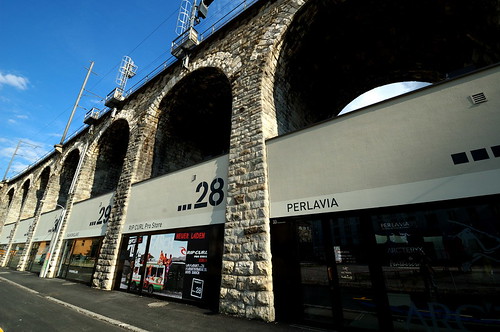
The Viadukt in Zurich uses an idea which I have already though of, which is to incorporate new spaces and shops underneath the exisiting structure. This would become beneficial within Queen Street as it would provide an alternative to the negative space created under the structure, and tie in with the concept of centralisation.
http://www.hubmag.de/wp-content/uploads/Viadukt.png
Here is another shot of the Viadukt, it shows the scale of the project. Obviously, Queen Street wouldn't be of this scale, but the concept should remain the same.
http://assets.inhabitat.com/wp-content/blogs.dir/1/files/2010/08/Main-Station-Stuttgart-11.jpg

http://www.metroplansydney.nsw.gov.au/Portals/0/images/bodyimages/transport.jpg
The sleek modern feel to this station is what I would like my station to look like.
http://www.chi-athenaeum.org/intarch/2007/IA0714.html
http://www.wallpaperhere.com/thumbnails/detail/20110624/modern-architecture-berlin-central-station-1280x1024.jpg
This is the new Berlin Station, which was designed using steel and glass in new ways. The whole station encompasses new ideas such as housing office units above the platform, as well as retail and public spaces dug into the ground. It therefore shows that a station can be more than simply a place of transit, but can also include many ideas such as public domain, user experience and transit orientated village.
http://www.thetransportpolitic.com/wp-content/uploads/2010/01/Denver-Union-Station-Commuter-Rail.png
While this station seems pretty generic, the use of open space and covering is interesting. It also encourages places to sit and socialise while waiting for transport. The use of structure is apparent throughout.
http://app.www.sg/data/usermedia/photos/categoryname_233200913345.jpg
This exemplar is more closely related to the idea of my design, there is an elevated track network. The roof structure is interesting and the form is futuristic, however, I think that it is more important to have a greater connection to the outside context.
http://farm5.static.flickr.com/4020/4521453768_56f6523bc1.jpg
The Viadukt in Zurich uses an idea which I have already though of, which is to incorporate new spaces and shops underneath the exisiting structure. This would become beneficial within Queen Street as it would provide an alternative to the negative space created under the structure, and tie in with the concept of centralisation.
http://www.hubmag.de/wp-content/uploads/Viadukt.png
Here is another shot of the Viadukt, it shows the scale of the project. Obviously, Queen Street wouldn't be of this scale, but the concept should remain the same.
http://www.metroplansydney.nsw.gov.au/Portals/0/images/bodyimages/transport.jpg
The sleek modern feel to this station is what I would like my station to look like.
Tuesday, 18 September 2012
Exemplars
After speaking to my tutor last week, I have decided that I am going to design a transport station for the envisioned pod system which appears within our future vision. Along with this, it was determined a good idea to also look at how the pods themselves will work. Not only in terms of function, but also ergonomics and procedure such as payment and timetabling etc.
As a result first I decided to look at examples of new pod transport which were already in existence, and hopefully over time I can abstract them to match the future scenarios.
From the first assignment it was already detemined how these pods would work, they would be;
Automated
High Speed
Futuristic
Frequent
Moderately sized
Stop at all stations
Automatic doors
Sustainable
These criteria limited the design on these pods. Some examples can be seen below.

http://www.wired.com/images_blogs/autopia/images/2008/10/15/podcars.jpg
When looking at these exemplars it became clear that most modern pod systems have the same exterior aesthetic. However, this example in particular show the various aspects of windows, doors, tracks and lights which must be a necessity in the design of such tranport systems. These example also shows the idea of an automated system, including the track on which the pod sits and how that produces power in the capsule.

http://www.wired.com/images_blogs/autopia/images/2008/10/15/podcar06_2.jpg
This exemplar shows some ideas of scale, including how big these pods need to be to accommodate a certain number of passengers. It can be seen that a fairly small capsule can provide enough space for four adults to comfortably sit. Therefore these pods do not need to be too large to suit a large number of people, but should be designed efficiently to provide enough comfort.

https://blogger.googleusercontent.com/img/b/R29vZ2xl/AVvXsEi4bwpdUUvpJDfx8jwwz4XyG7420d5VmMsYd_n6L82MD1L_IsWc0MvJ-LAY7GJAHQKiI0T-jCCIbH389hdjyERD6vRr8WCFo5J7KAYI7MV_uMNpNP7HpcXDjfJTN1JTcq81SYW47c2p9g_C/s1600/masdar+city4-podcar-abu-dhabi.jpg
This exemplar comes from the new masdar city in Abu Dhabi, which has been designed by Norman Foster. It provides a different alternative to the above examples in the fact that the idea is turned on its head, literally. This pod system runs along tracks above it rather than on a road of platform below it. As a result the system appears more open and free, with less structure and more visual camoflage within the city.

http://www.blogcdn.com/green.autoblog.com/media/2009/04/masdar-prt-01.jpg
This example is simply another pod system, albeit with more futuristic aesthetic and appeal to it. While it is also automated, there is a lack of track or structure which the pod runs along and is more of a paved roadway.
As a result first I decided to look at examples of new pod transport which were already in existence, and hopefully over time I can abstract them to match the future scenarios.
From the first assignment it was already detemined how these pods would work, they would be;
Automated
High Speed
Futuristic
Frequent
Moderately sized
Stop at all stations
Automatic doors
Sustainable
These criteria limited the design on these pods. Some examples can be seen below.
http://www.wired.com/images_blogs/autopia/images/2008/10/15/podcars.jpg
When looking at these exemplars it became clear that most modern pod systems have the same exterior aesthetic. However, this example in particular show the various aspects of windows, doors, tracks and lights which must be a necessity in the design of such tranport systems. These example also shows the idea of an automated system, including the track on which the pod sits and how that produces power in the capsule.
http://www.wired.com/images_blogs/autopia/images/2008/10/15/podcar06_2.jpg
This exemplar shows some ideas of scale, including how big these pods need to be to accommodate a certain number of passengers. It can be seen that a fairly small capsule can provide enough space for four adults to comfortably sit. Therefore these pods do not need to be too large to suit a large number of people, but should be designed efficiently to provide enough comfort.

https://blogger.googleusercontent.com/img/b/R29vZ2xl/AVvXsEi4bwpdUUvpJDfx8jwwz4XyG7420d5VmMsYd_n6L82MD1L_IsWc0MvJ-LAY7GJAHQKiI0T-jCCIbH389hdjyERD6vRr8WCFo5J7KAYI7MV_uMNpNP7HpcXDjfJTN1JTcq81SYW47c2p9g_C/s1600/masdar+city4-podcar-abu-dhabi.jpg
This exemplar comes from the new masdar city in Abu Dhabi, which has been designed by Norman Foster. It provides a different alternative to the above examples in the fact that the idea is turned on its head, literally. This pod system runs along tracks above it rather than on a road of platform below it. As a result the system appears more open and free, with less structure and more visual camoflage within the city.
http://www.blogcdn.com/green.autoblog.com/media/2009/04/masdar-prt-01.jpg
This example is simply another pod system, albeit with more futuristic aesthetic and appeal to it. While it is also automated, there is a lack of track or structure which the pod runs along and is more of a paved roadway.
Sunday, 16 September 2012
Week 8...
The lecture this week was conducted regarding the various facets that sustainability entails within our world. The main focus was on the fact that sustainability is not necessarily about making things green.
It was said that simply making things green or green-washing an urban landscape is a fairly naive and simplistic approach to making an environment more sustainable. It was noted that within these ideas, a number of factors such as embodied energy and transportation are neglected, therefore failing to create a holistically sustainable intention.
The lecture went on to define the normal linear approach to buildings, which includes a cradle to grave system. In first year I remember being told that a building should expect to last 50 years. However, it wasn't outlined what should then happen to the building afterwards, however presumably it would be knocked down.
These days, the intention behind buildings has shifted. It is expected that a building can be renovated, or redeveloped to continue its lifespan. Even if a building should be knocked down, the main principal should be to salvage and reuse fittings, furniture, and even building materials within the next project. In this case the idea of sustainbility is to continue to increase and adapt to changing contexts and ideas rather than to simply start again.
This will hopefully be reiterated within my design. Providing a building which can be adapted to suit changing idealogies and leave existing infrastructure in place without needing to demolish and change anything.
This building should simply insert itself into the context, improving quality of life and adding to it, not ideally altering it.
It was said that simply making things green or green-washing an urban landscape is a fairly naive and simplistic approach to making an environment more sustainable. It was noted that within these ideas, a number of factors such as embodied energy and transportation are neglected, therefore failing to create a holistically sustainable intention.
The lecture went on to define the normal linear approach to buildings, which includes a cradle to grave system. In first year I remember being told that a building should expect to last 50 years. However, it wasn't outlined what should then happen to the building afterwards, however presumably it would be knocked down.
These days, the intention behind buildings has shifted. It is expected that a building can be renovated, or redeveloped to continue its lifespan. Even if a building should be knocked down, the main principal should be to salvage and reuse fittings, furniture, and even building materials within the next project. In this case the idea of sustainbility is to continue to increase and adapt to changing contexts and ideas rather than to simply start again.
This will hopefully be reiterated within my design. Providing a building which can be adapted to suit changing idealogies and leave existing infrastructure in place without needing to demolish and change anything.
This building should simply insert itself into the context, improving quality of life and adding to it, not ideally altering it.
Monday, 10 September 2012
Design Ideas
Within the tutorial this week, we met with our primary tutor for the remainder of the semester and reviewed our first assignment before discussing possible directions for our next assignment.
While I was waiting for the tutor to come around and speak to me I began to jot down possible buildings which could be found within the future of my site and started to list aspects that these buildings might contain. This was the result...
Continuing my interest from the previous week, I am still inclined to design a pod station, which my tutor also said was a good idea and that the scale of the project wasn't too small due to the fact that these types of building can carry a lot of complexity within them. However, I still haven't let go of the other ideas and will try to use the same mental stance within my pod design as I would for them i.e. imagining the pod station within a future context and how people will use it.
Saturday, 8 September 2012
Week 7...
The lecture this week primarily revolved around the introduction of the next assignment to the class. The basic idea is to extrapolate upon the architectural possibilities discovered in the last part of the first assignment and concentrate on one building or architectural installation and design it within the context that has already been established.
While this sounds simple, the criteria which the design is to be measured against once again begin to complicate and confuse the primary aim. I will need to revisit this lecture multiple times to fully understand what is expected of the next assignment.
However, despite this, I am looking forward to starting this design project and hopefully learning some new and beneficial presentation skills such as animations and evocative imagery.
A further note. It was described in the lecture that the proposed building should be set within the 2020s, a time frame not even a decade away. Because the final panels we created were set within the 2050s, and were reasonably established, it can be considered that this architectural entity is to be "the seed" or "the start" of producing that overall urban context.
While this sounds simple, the criteria which the design is to be measured against once again begin to complicate and confuse the primary aim. I will need to revisit this lecture multiple times to fully understand what is expected of the next assignment.
However, despite this, I am looking forward to starting this design project and hopefully learning some new and beneficial presentation skills such as animations and evocative imagery.
A further note. It was described in the lecture that the proposed building should be set within the 2020s, a time frame not even a decade away. Because the final panels we created were set within the 2050s, and were reasonably established, it can be considered that this architectural entity is to be "the seed" or "the start" of producing that overall urban context.
Sunday, 2 September 2012
Presentation Feedback
The feedback from the tutors was relatively sparse, no doubt due to the strict time limit each group had to present. However, the feedback appeared to be generally good, the tutors appeared to be in agreement with what we said and the few questions they did ask were answered quickly and easily.
Overall I think the tutors were happy with the project and the direction which we had taken. I believe that I am now in a good place to begin the next assignment which is to design a building or architectural entity within this urban context.
At this stage ideally I would like to design a pod transport station, however I feel the scale of the design might not be big enough to suit the brief. Failing that I am also interested in designing a school, and imagining the new ways in which schools will be run within the future.
Overall I think the tutors were happy with the project and the direction which we had taken. I believe that I am now in a good place to begin the next assignment which is to design a building or architectural entity within this urban context.
At this stage ideally I would like to design a pod transport station, however I feel the scale of the design might not be big enough to suit the brief. Failing that I am also interested in designing a school, and imagining the new ways in which schools will be run within the future.
Subscribe to:
Posts (Atom)